Sphere and Cosm: The New Era of Immersive Experience
.
Written by zeepada | Edited by @syntaxional
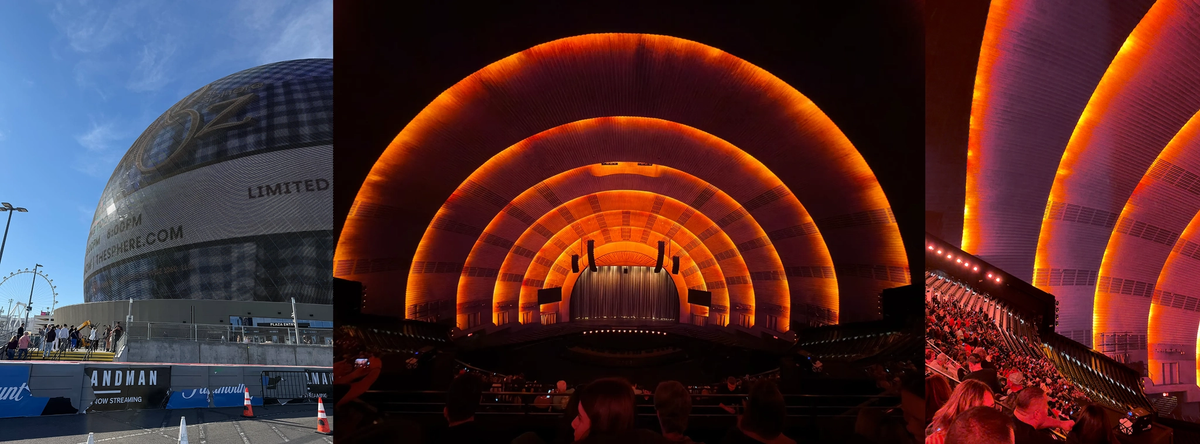
Looking back, we were enjoying immersive experiences long before we ever learned the words AR or VR. The desire to feel something beyond a flat, two-dimensional screen has always been there. Even before the technology could catch up. And in 2024–2025, two venues emerged in the United States that answered that desire at an entirely new scale: Sphere in Las Vegas, and Cosm, with locations spreading across the country.
This is a review of seeing a classic film at each. At Sphere: The Wizard of Oz (Victor Fleming, 1939). At Cosm: Willy Wonka & the Chocolate Factory (Mel Stuart, 1971). And a reflection on what those experiences reveal about where immersive media is headed.
1. A History of Immersion: The Technology Is New. The Desire Isn't.
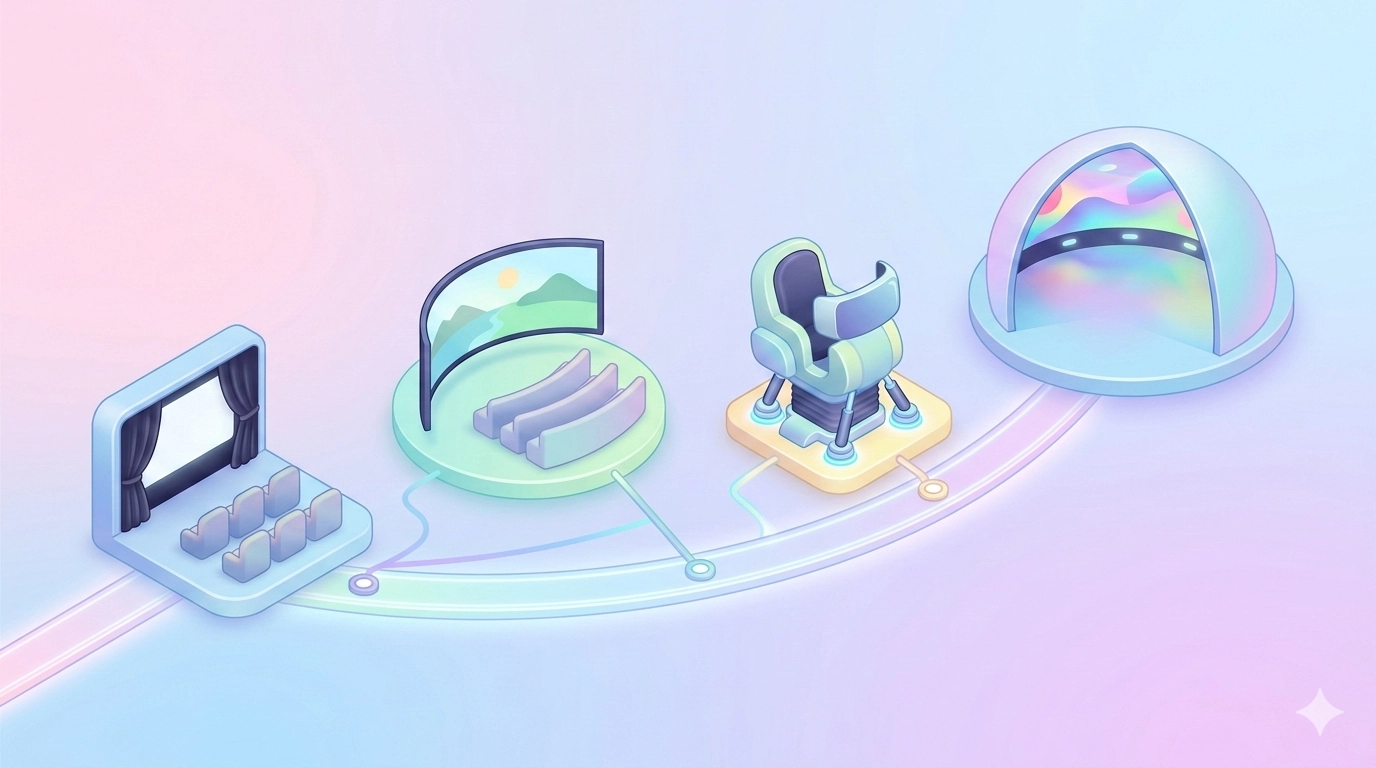
Cinerama in the 1950s filled a massive curved screen using three synchronized projectors. IMAX arrived in the 1970s and, half a century later, hasn't gone anywhere. Disney's Star Tours (1987), 4D cinemas, aespa's VR concert — the list goes on.
What all of these have in common is this: they take something familiar and make it more immersive. They don't ask you to learn a new behavior. You're still watching a movie, still riding a ride, still watching a game. They simply add a dimension to something you already know how to do.
That's the key insight. It's never the technology itself that draws people in. It's the experience the technology makes possible.
2. Sphere and Cosm: Two Domes, Two Philosophies
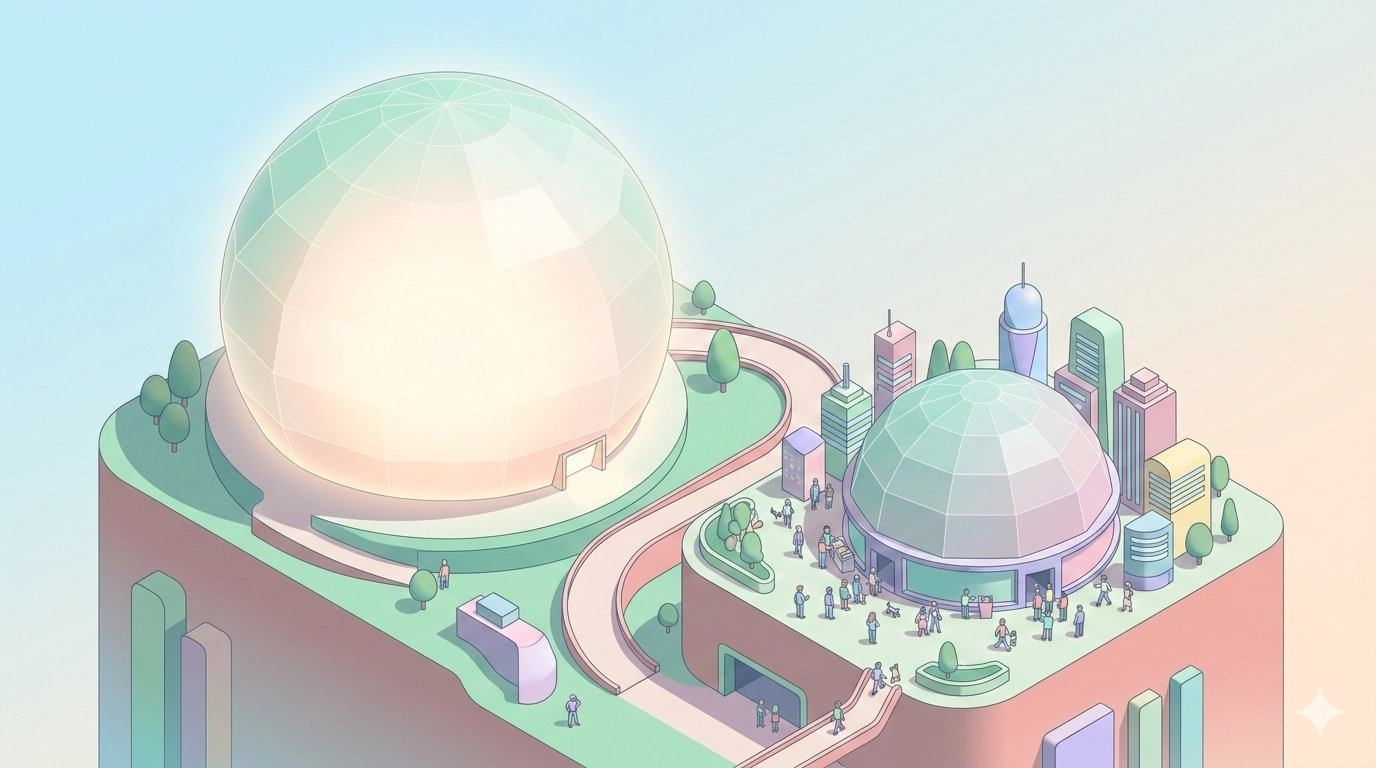
Both venues wrap audiences in immersive content via enormous curved displays. But their approaches are quite different.
Sphere: A Landmark Built on Scale
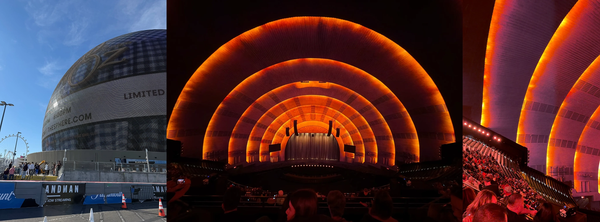
Opened in Las Vegas in September 2023, Sphere is the world's largest spherical structure, 112 meters tall, 157 meters wide. Inside: roughly 14,900 m² of 16K wraparound LED display, more than 167,000 individually amplified speakers using HOLOPLOT 3D beamforming audio, and 10,000 haptic seats capable of delivering wind, temperature, scent, and vibration.
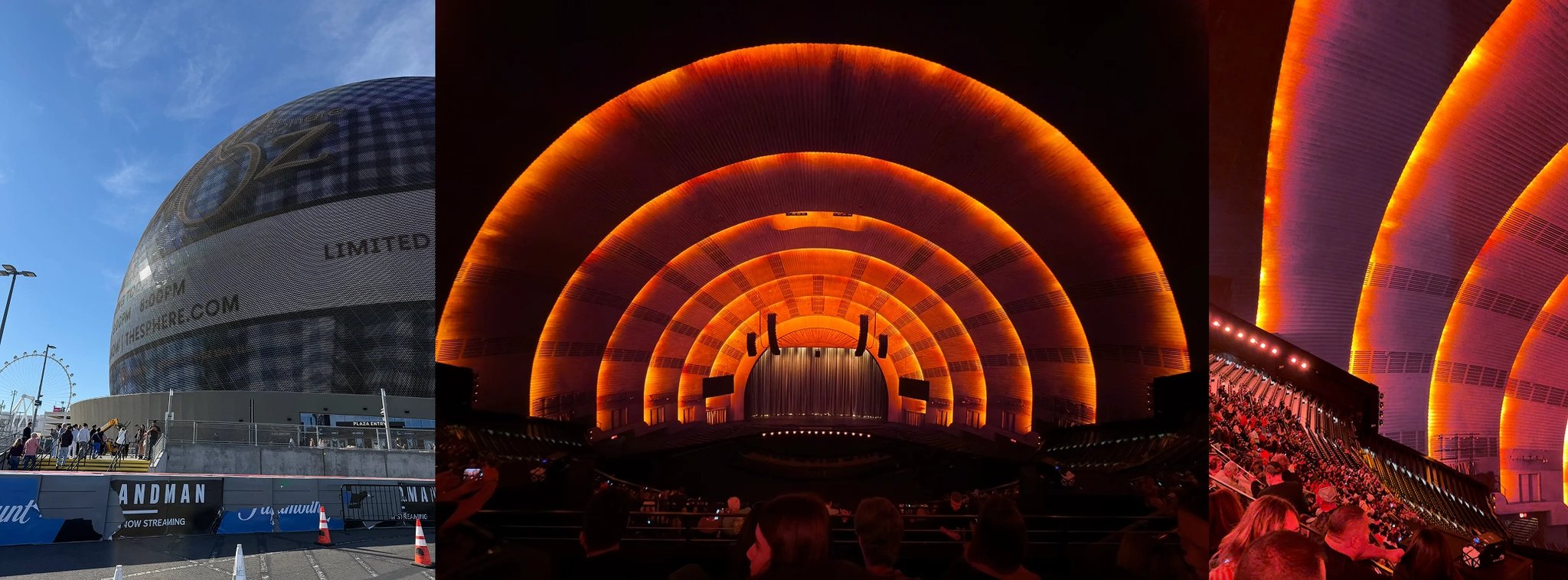
The exterior — the Exosphere, about 54,000 m² of LED — has already become a new fixture of the Las Vegas skyline. Since opening with a U2 residency, Sphere has hosted Eagles and Backstreet Boys concerts, screened Darren Aronofsky's original film Postcard from Earth (2023), and as of August 2025, is running The Wizard of Oz.
Cosm: VR Without the Headset
Cosm traces its roots to Evans & Sutherland, a company that had been developing planetarium technology since the 1940s. Cosm acquired that legacy and layered modern LED technology on top of 75 years of dome expertise. Venues are now open in LA (June 2024) and Dallas (2024), with Atlanta scheduled for June 2026 — part of a longer-term goal of over 100 locations.
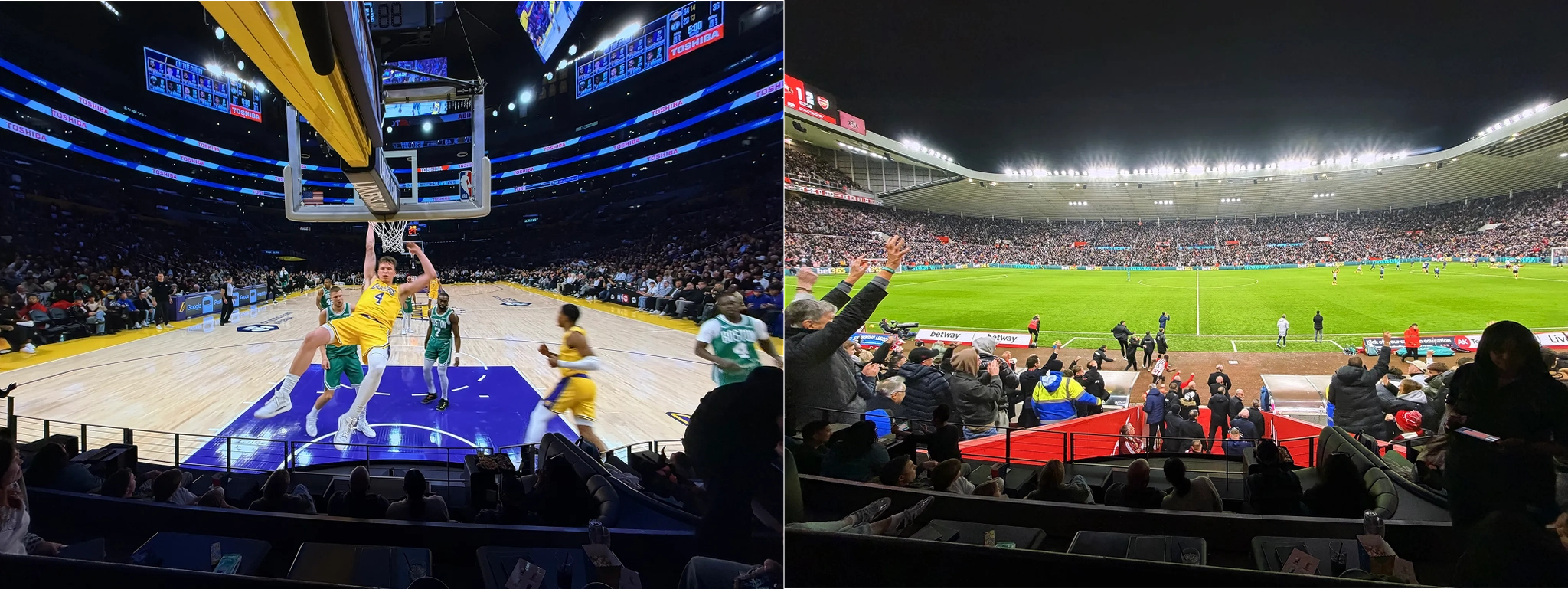
The centerpiece is an 87-foot-diameter (roughly 26.5m) LED dome with 12K+ resolution. Seating around 2,000 people, the audience sits inside the dome and is surrounded by the content. Cosm calls this "Shared Reality" (SR).
Programming leans heavily on live sports — NBA, NFL, NHL, UFC, EPL — alongside a growing slate of classic films through a Warner Bros. partnership: The Matrix (June 2024), Willy Wonka & the Chocolate Factory (November 2025–), and Harry Potter and the Sorcerer's Stone (May 2026, upcoming).
At a Glance
| Sphere | Cosm | |
|---|---|---|
| Location | Las Vegas (1 venue, expansion planned) | LA, Dallas, Atlanta, and more |
| Opened | September 2023 | June/August 2024 (LA/Dallas) |
| Scale | 112m tall, 157m wide / ~17,600 seats | 87ft dome diameter / ~2,000 seats |
| Display | 16K, ~14,900 m² LED | 12K+, 87ft LED dome |
| Audio | 167,000+ individual speakers, HOLOPLOT 3D beamforming | Immersive surround sound |
| 4D Effects | 10,000 haptic seats, wind/temperature/scent/drones | In-seat table service, food & drink ordering |
| Main Content | Major concert residencies + cinematic experiences | Live sports + classic film SR |
| Ticket Price | ~$217 (concerts), $100+ (films) | ~$22–$77 |
3. The Wizard of Oz at Sphere — The Power of Scale
The Wizard of Oz (1939) is, above all else, famous for that moment — the shift from black-and-white Kansas into the Technicolor world of Oz. Sphere took this 86-year-old classic and completely reimagined it for a 16K dome.
The Technical Challenge
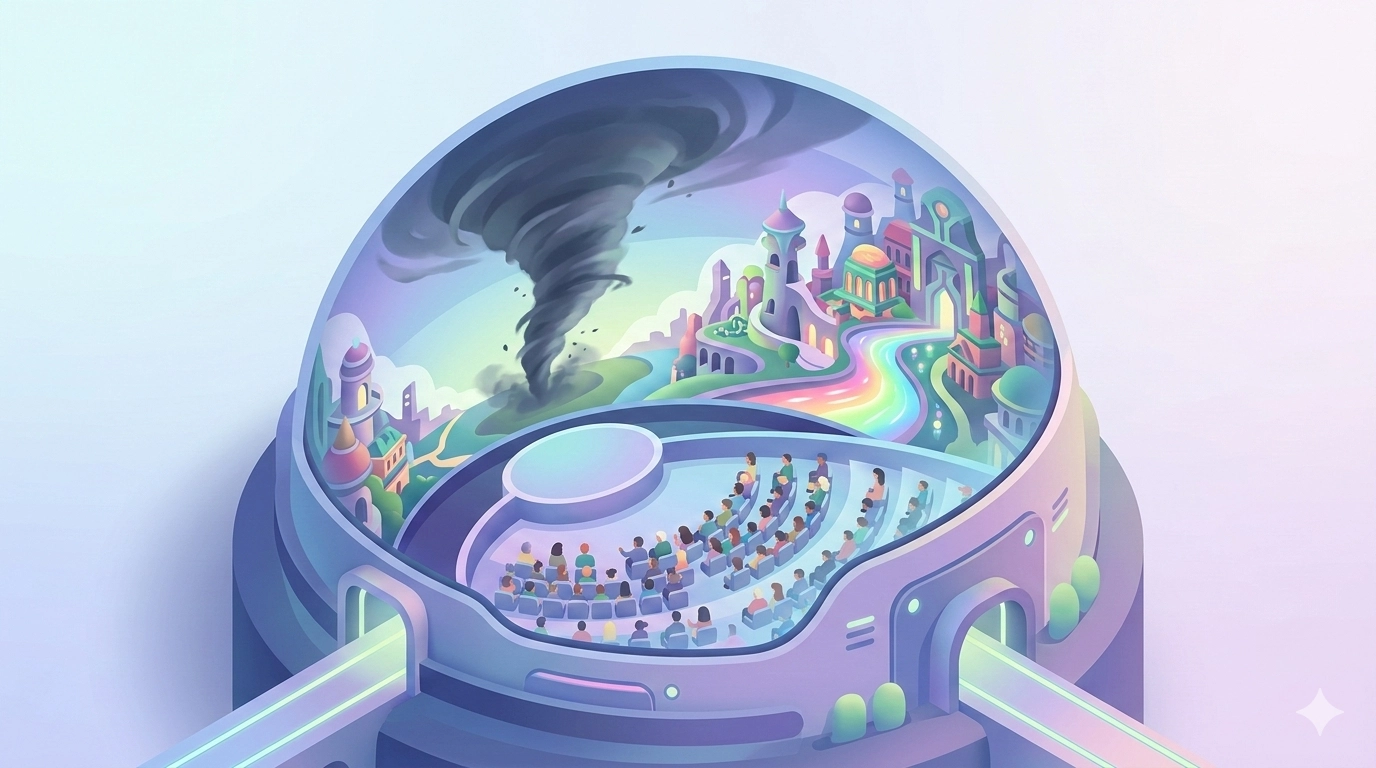
The original 1939 film footage was low-resolution and shot in a conventional rectangular frame — ill-suited for nearly 15,000 square meters of curved LED. Every scene had to be deconstructed and reformatted. Google DeepMind's AI was used to extend backgrounds, add characters beyond the original frame edges, and animate what had been static painted backdrops — adding moving clouds, birds, and more. The entire score was re-recorded with a full orchestra. Production cost: nearly $100 million, roughly four times the original film's inflation-adjusted budget. The runtime was also edited down from 102 to 75 minutes, though the cuts were seamless enough that nothing felt missing.
The Experience
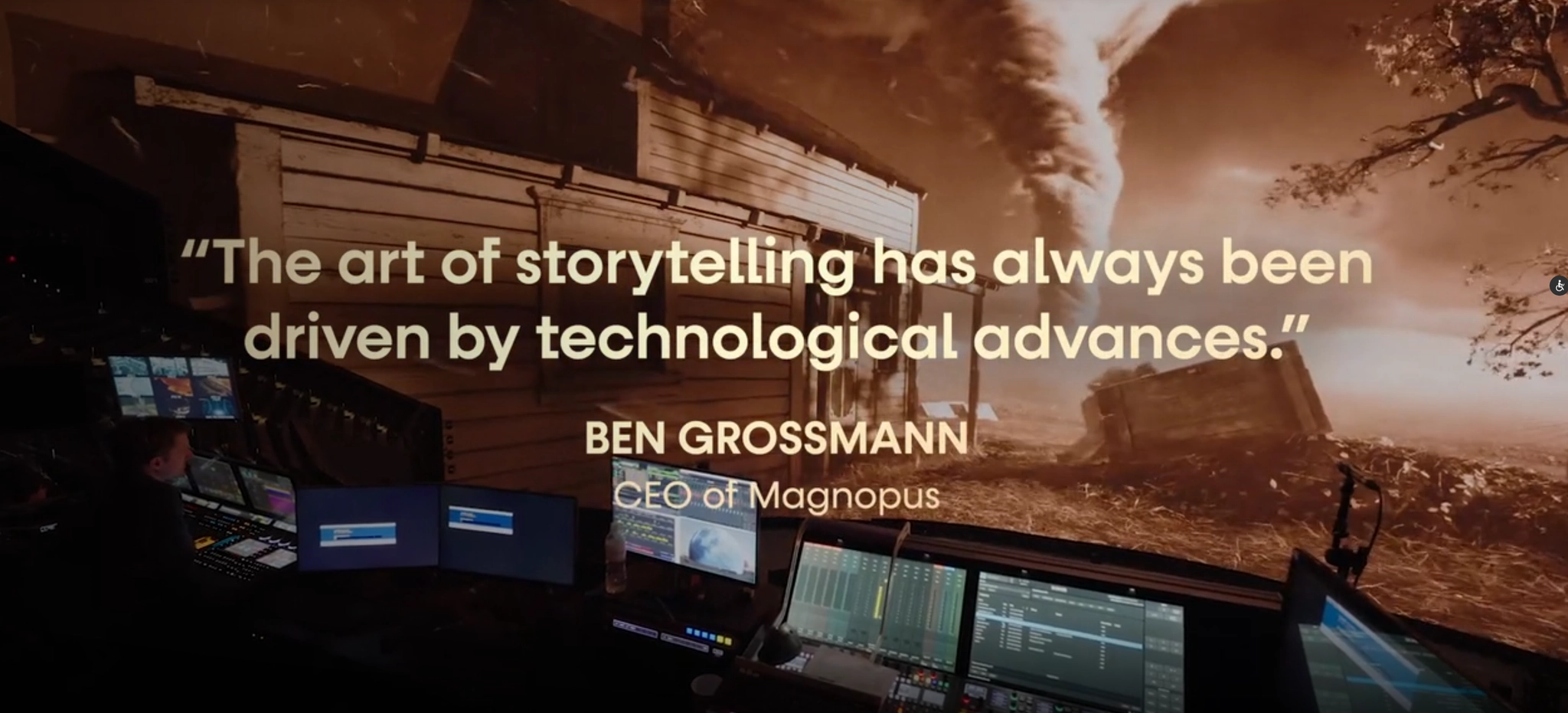
Walking in, the scale hits you immediately. There's a clever pre-show gag where Sphere's enormous display faithfully recreates the look of a traditional movie theater — velvet curtains, glowing exit signs, the whole setup. Then the film begins, and suddenly your entire field of vision is filled with sepia-toned Kansas. Oh right. I'm inside Sphere.
That said, there were fewer moments that truly exploited the full dome than I expected. The tornado sequence and the arrival at the Emerald City were genuinely spectacular — those were the moments where Sphere's potential was undeniable. But during dialogue-heavy scenes, the sheer size of the space could feel underused, almost hollow.
If anything, the experience left me more curious about what a concert at Sphere must be like. Twenty thousand people cheering together, with visuals wrapping around the entire dome — that combination feels more native to the space than a film adaptation does. Sphere might be more fundamentally a live performance venue than a cinema.
4. Willy Wonka at Cosm — Intimate Immersion
Where Sphere dismantles and rebuilds the original film itself using AI, Cosm takes a different approach: the source film plays intact, within a central rectangular frame, while the surrounding dome space is filled with newly created animation and visual effects. Rather than altering the movie, Cosm expands the world around it.
The Experience
For sheer immersive impact, Cosm was, honestly, the stronger experience.
And the reason is counterintuitive: it's smaller. At Sphere, the venue is so vast that the audience, the seats, and the edges of the screen remain visible in your peripheral vision. At Cosm, the dome is compact enough that no matter where you look, you can't easily find the boundary between the screen and the real world. It feels like wearing a VR headset — without actually wearing anything.
The pre-show demo was striking. Cosm ran a sports highlights reel — NBA and NHL footage playing across the full dome — and within seconds, any skepticism I'd had about watching sports in a place like this was gone. Courtside perspective, no headset, a beer in hand, friends sitting next to you. A few seconds of footage was all it took.
The film itself delivered. When the doors to Wonka's chocolate factory swing open, the dome floor lights up and the visuals burst beyond the central frame — suddenly the audience feels like they're standing on the factory lawn. The effect is deceptively simple and completely effective.
The standout moment came during the Fizzy Lifting Drinks scene. As Charlie and Grandpa Joe float upward after sipping the carbonated concoction, Cosm slowly shifts the film's frame toward the top of the dome. The surrounding space fills with bubbles. I found myself craning my neck upward for a long moment before realizing: the screen had moved. My body responded before my brain could catch up. That's the real thing. That's genuine immersion.
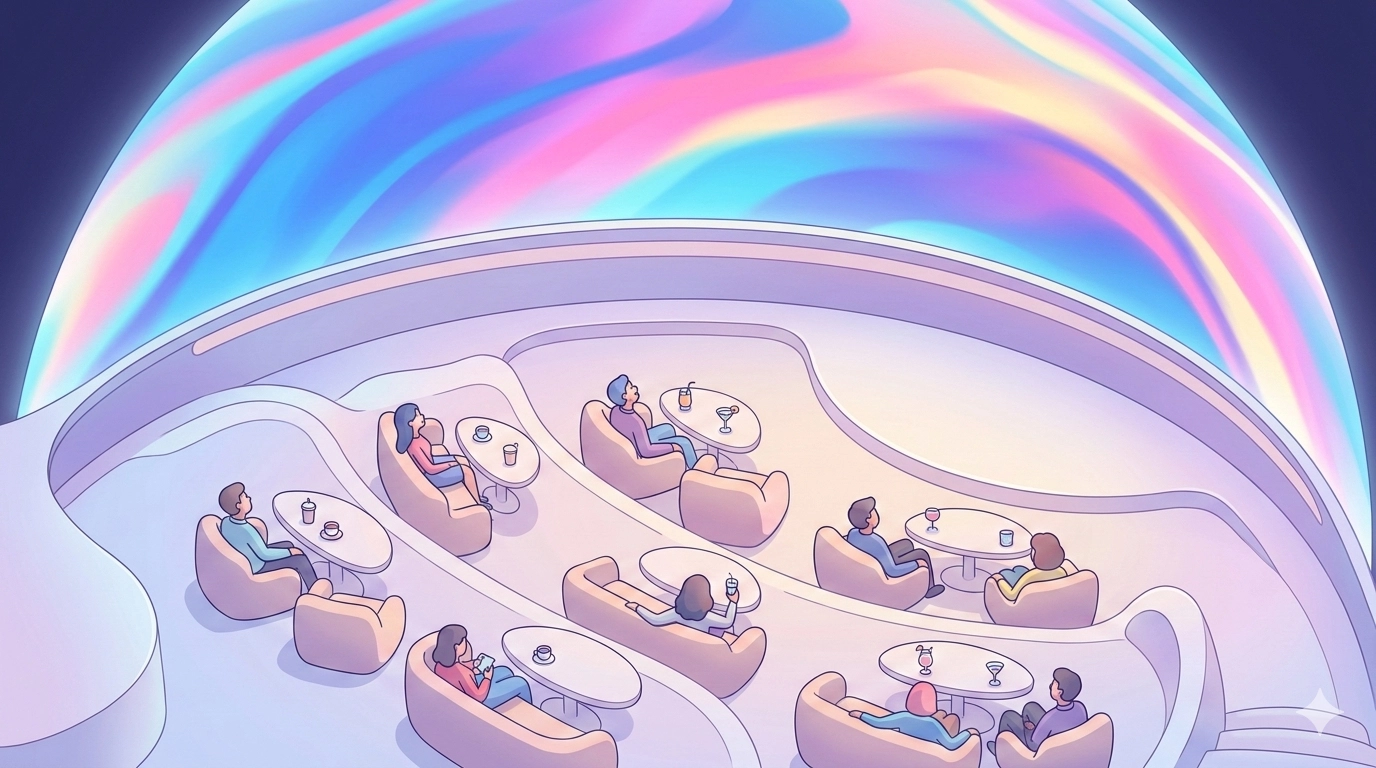
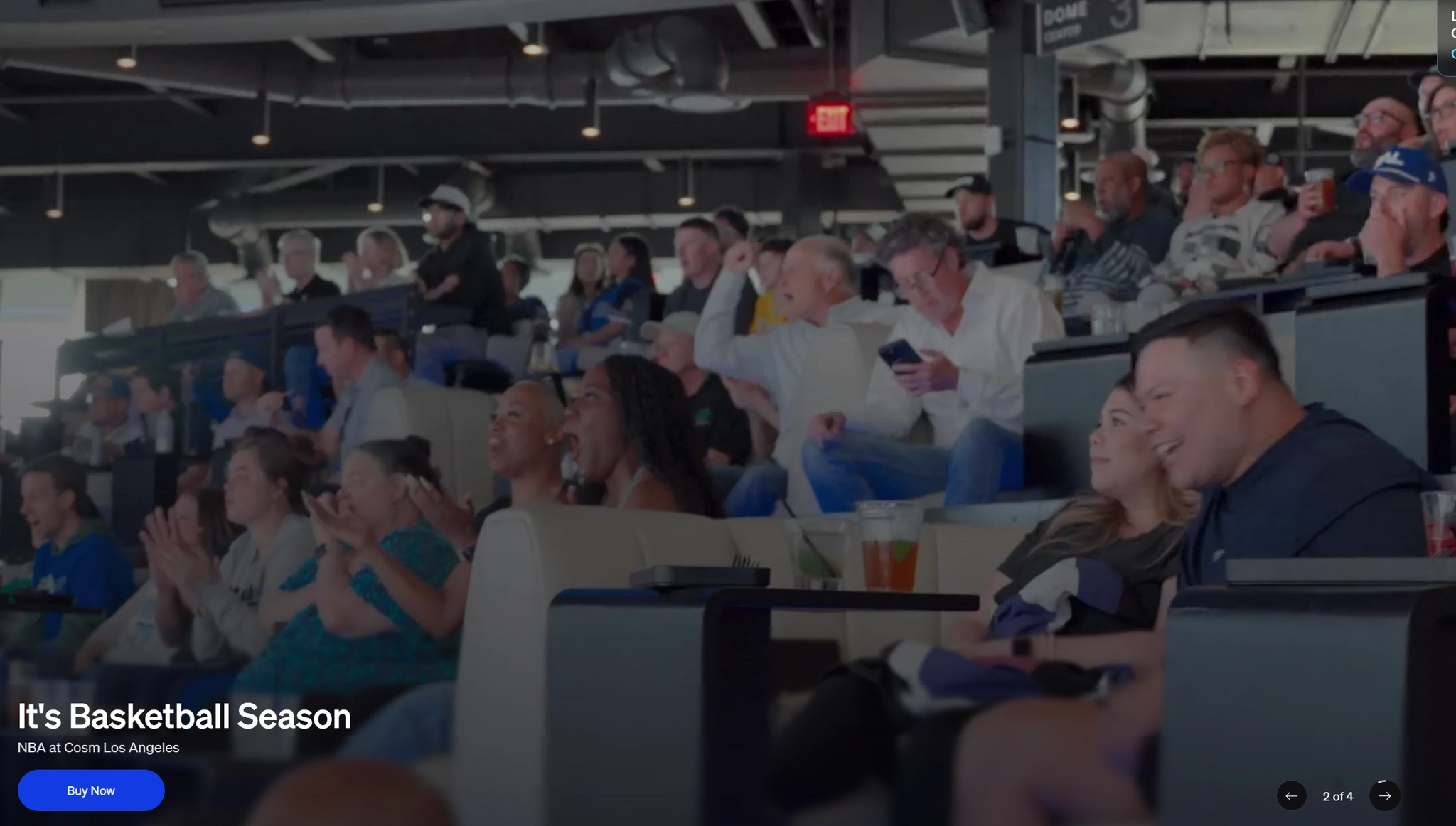
Each seat has a small side table for ordering food and drinks throughout the screening — essentially "movie theater meets bar meets VR." Being able to sip a Wonka-themed cocktail while floating inside a chocolate factory is exactly as absurd and delightful as it sounds.
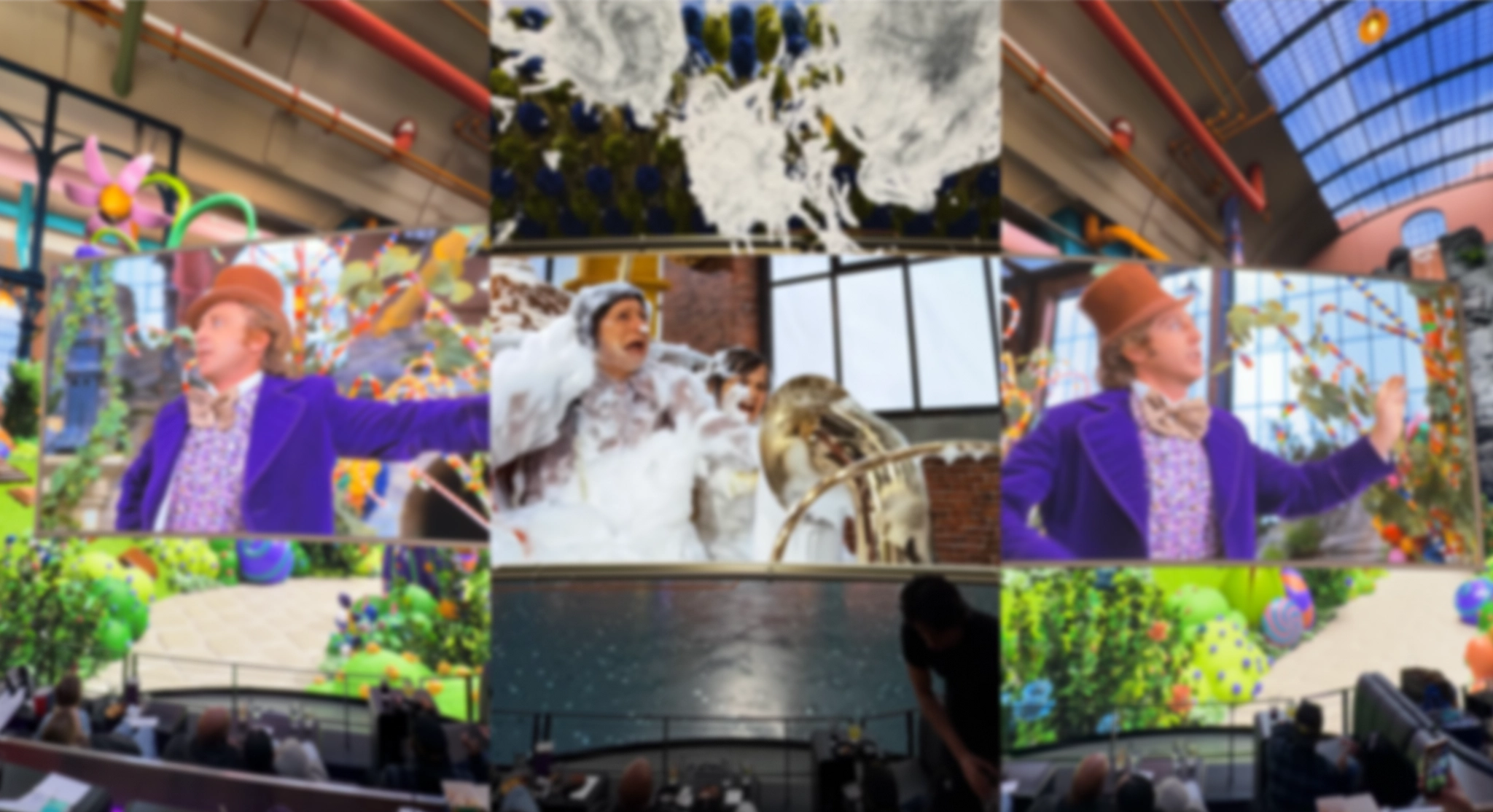
A member of our group had previously seen The Matrix at the same Cosm location. Their verdict: Willy Wonka was noticeably more polished — the extended visuals, the environmental effects, the overall design. Cosm is clearly learning from each production and iterating.
Harry Potter and the Sorcerer's Stone is scheduled for May 2026, timed to the film's 25th anniversary. Butterbeer and Chocolate Frogs are reportedly part of the experience. Expectations are high.
5. Sphere vs. Cosm: Which Is the Better Experience?
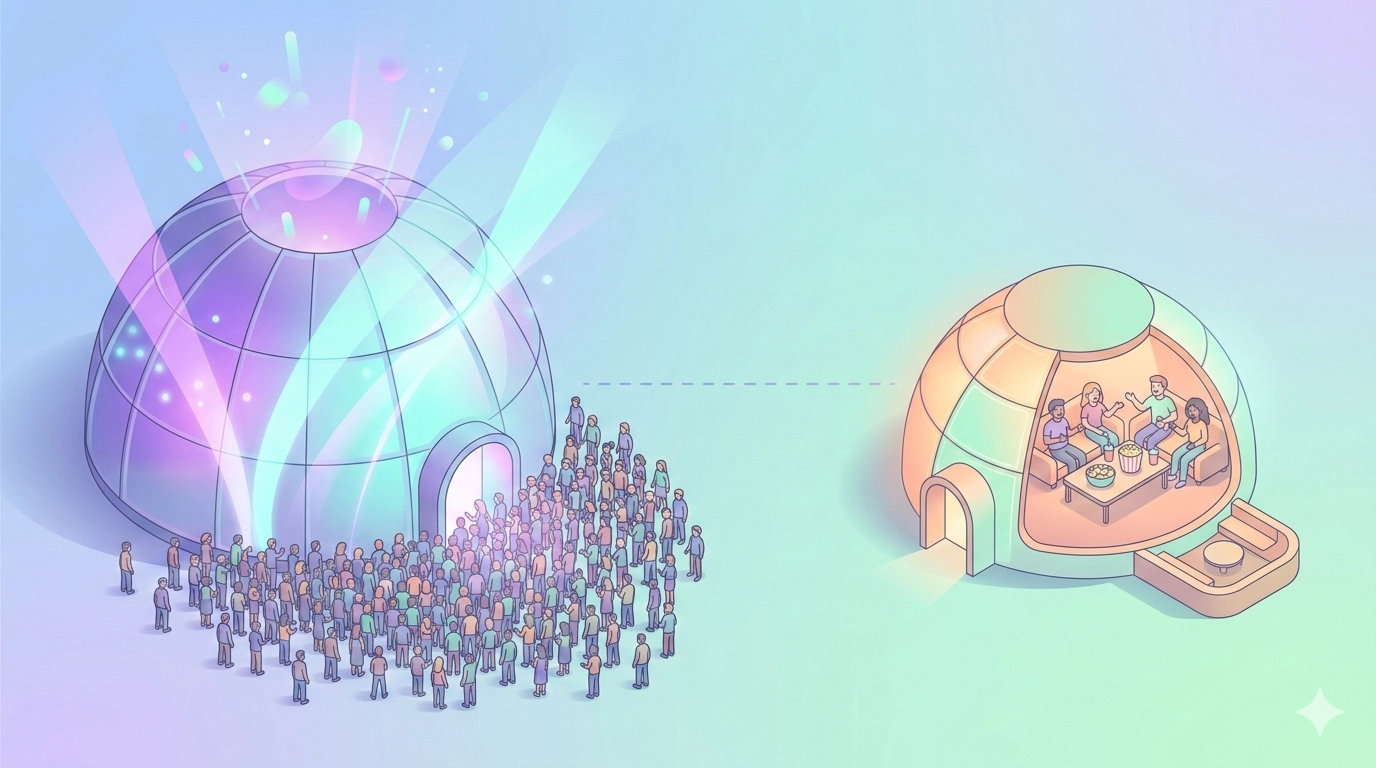
A direct comparison misses the point. They're aiming at different things.
Sphere is a landmark you visit once. Monumental scale, full-body physical effects (flying monkeys overhead, wind from an actual tornado, apples falling), and a $100 million production budget. It is, without qualification, a spectacle.
Cosm is a place you go back to. It's neighborhood-sized, reasonably priced, and built around the experience of being there with other people — food, drinks, friends. Rolling out 100+ venues nationwide is less a content play than a reinvention of the movie theater itself.
Their approaches to film adaptation are equally contrasting. Sphere deconstructs the original and rebuilds it for the dome — more dramatic, but with the risks that come with heavy AI intervention. Cosm preserves the original and builds outward from it — less radical, but true to the texture of the source material while still adding genuine environmental depth.
6. Where This Is Going
Cosm calls its format Shared Reality. Sphere uses its own branding: the Sphere Experience. The names don't really matter. Both are answering the same question:
How do you pull people deeper in?
After visiting both, I came away with one conviction: if the experience is good, people will find it. Nobody sitting inside Cosm watching an NBA game is thinking, "This is a 12K+ LED dome utilizing SR technology." They're thinking: I feel like I'm courtside.
Content Is Everything
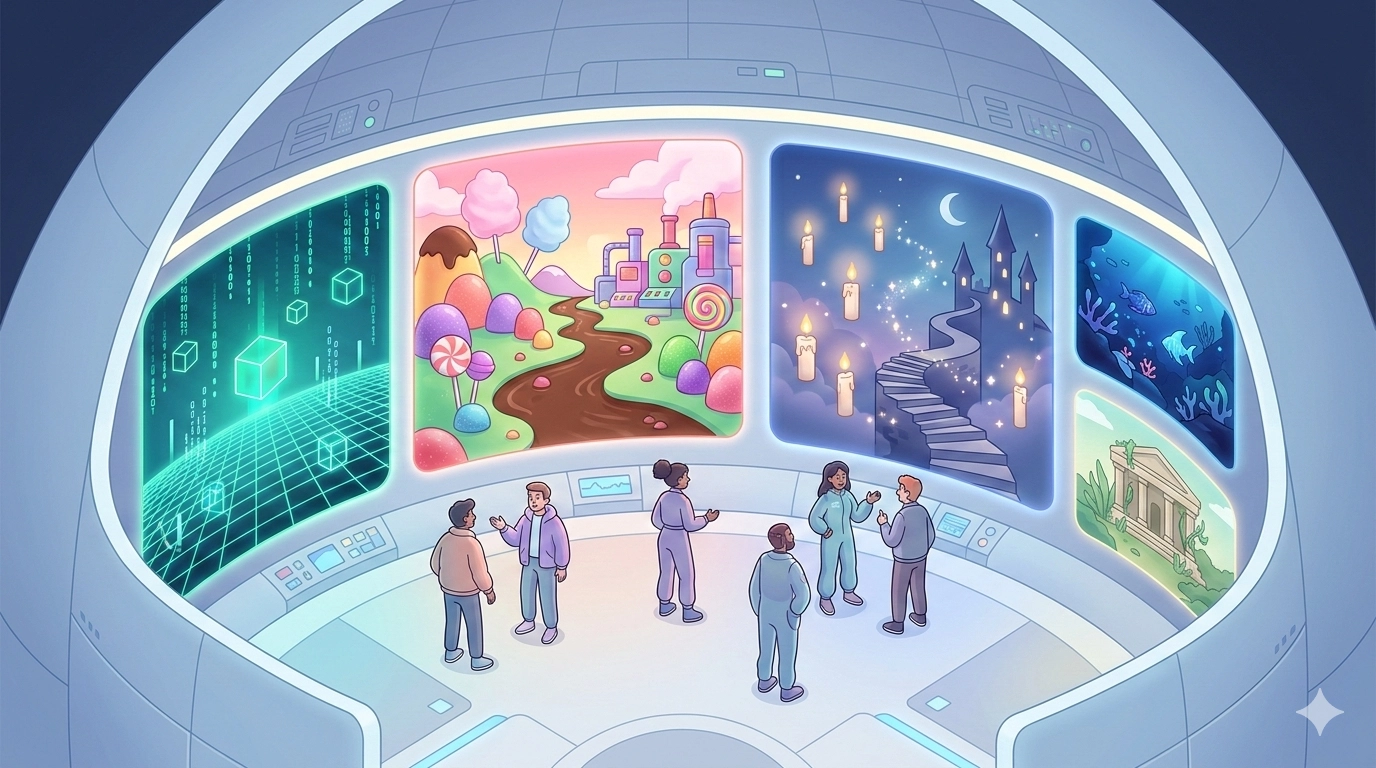
The same venue delivers a meaningfully different experience depending on what's playing. Willy Wonka at Cosm is more immersive than The Matrix at Cosm. The Backstreet Boys concert at Sphere is a different thing entirely from The Wizard of Oz at Sphere. No matter how large or sophisticated the dome, if the content doesn't fill the space — if it doesn't use what the venue makes possible — it still just feels like a big curved screen.
Cosm's trajectory is encouraging: the progression from The Matrix to Willy Wonka to Harry Potter shows visible improvement in how each property is adapted for the dome environment. The goal isn't to project a movie onto a large surface. It's to design an immersive experience around a specific piece of content.
The VR Headset Question
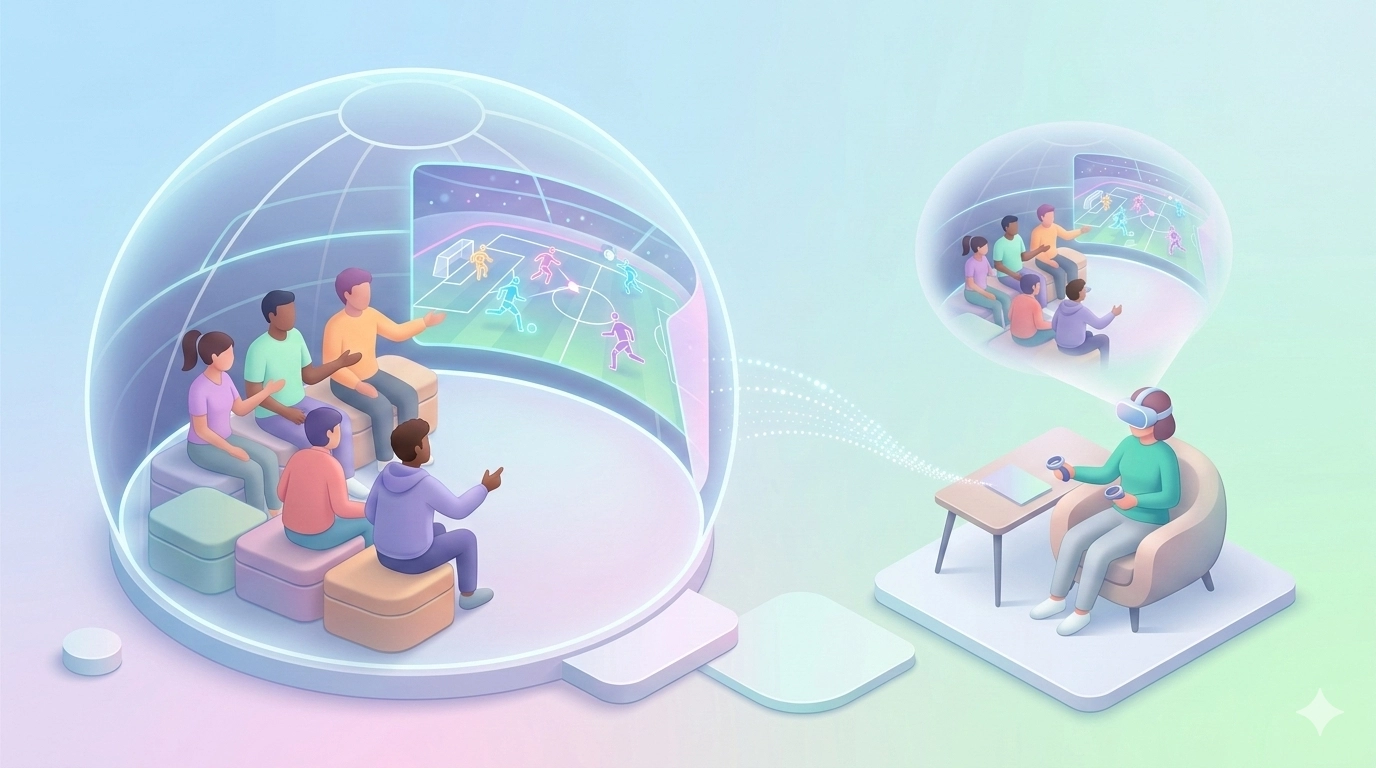
What Cosm and Sphere demonstrate isn't that VR headsets are unnecessary — it's that the demand for immersive experience is real and large. In fact, watching sports at Cosm made me think almost immediately: what if I could have this at home? That thought is the VR headset use case, stated naturally.
The challenge is that current VR headsets — outside of purpose-built commercial experiences like Amaze — haven't solved the two things Cosm does best:
- Social presence: the ability to share a beer with the person next to you, to hear their reactions, to feel the crowd
- Zero friction: nothing on your face, nothing to set up, nothing to adjust
In the context of watching films or sports together, those are the problems VR still needs to solve. The question isn't whether the display is good enough. It's whether the experience can be social, comfortable, and natural, all at once.
Closing Thoughts
VR, AR, MR, SR. The more acronyms, the clearer the underlying thing becomes.
People want experiences that are slightly bigger, slightly deeper than everyday life. The feeling a kid gets from a MaxRider in a mall lobby — the discovery that you can feel the thrill of a ride without actually being on one. The realization, sitting in a dome, that you can feel like you're courtside without having a courtside seat.
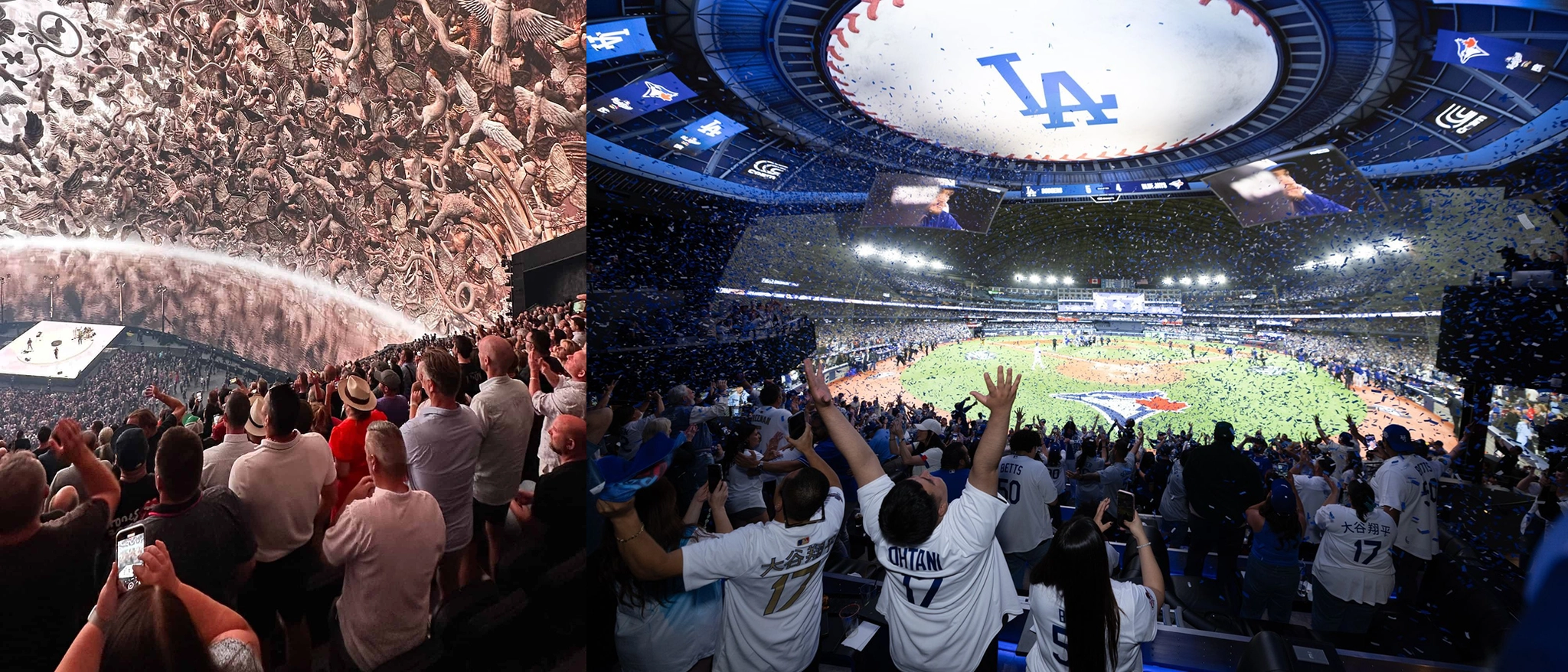
Maybe the most important element has nothing to do with the technology at all. Maybe it's simply: what and who you're watching with.
Whatever the format, whatever the acronym, if the experience is worth having, people will show up. Sphere has shown us the ceiling. Cosm is figuring out how to make it part of everyday life.
What remains to be seen is how these venues push further, and how — eventually — this kind of immersion meets the devices we wear on our faces. A lot is still unresolved. But one thing isn't:
The era of immersive experience has already begun. And at its center, it's not the technology that matters most.
It's the content.